
Key Takeaways:
- Green wall installation costs up to $175 per square foot with monthly maintenance running $300 to $1,000 — making professional management non-negotiable, not optional.
- Potted plants can raise indoor humidity from 29.1% to 49.2% with just 18 plants, directly reducing respiratory issues, virus transmission, and lost productivity.
- Without professional oversight, DIY potted plant survival rates fall to just 40% to 60%, turning a low-cost option into a recurring replacement expense.
- Green walls reduce ambient noise by 9 to 11 dB — a measurable acoustic benefit that potted plants alone cannot deliver.
- Preserved planter inserts meet LEED, WELL, and Fitwel certification requirements with zero maintenance, making them the strongest low-effort sustainability option available.
Greenery in the workplace is a proven investment. The question is which format delivers the best return for your specific space, budget, and goals. Green walls and potted plants each bring distinct advantages — and distinct trade-offs. Here is a clear breakdown of both so you can decide with confidence.
What Are Green Walls and How Do They Benefit Office Environments?
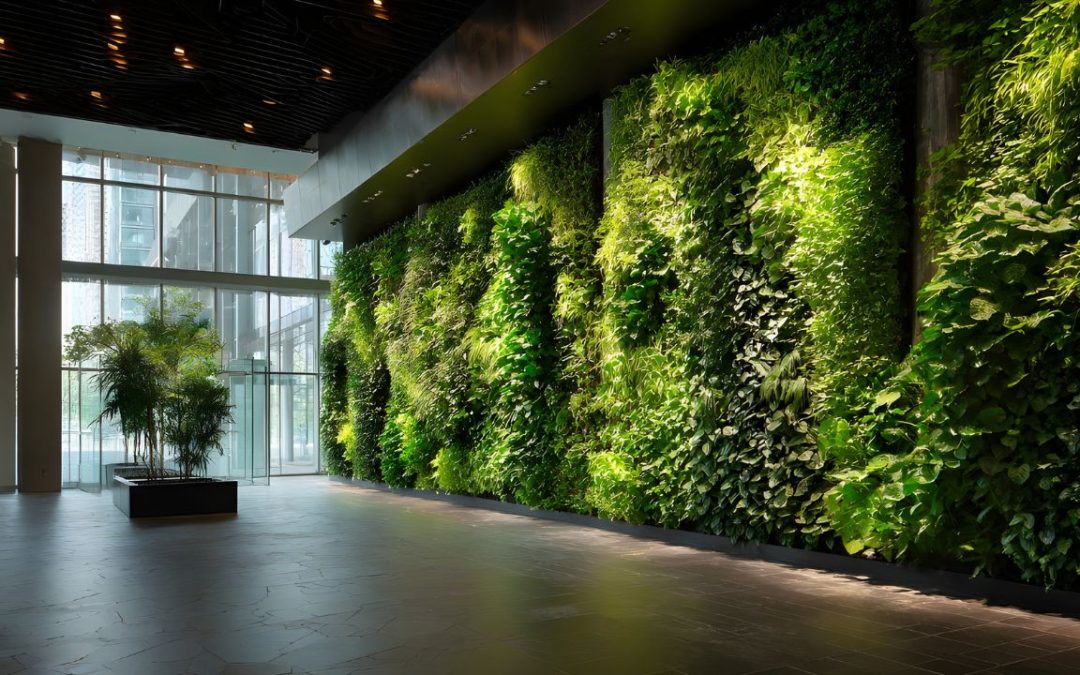
Green walls are vertical plant installations that turn unused wall space into a living design feature. They do more than look impressive — they actively change the acoustic, thermal, and psychological quality of the spaces they occupy.
How do green walls enhance office aesthetics and employee well-being?
A green wall transforms a sterile interior into an inviting, dynamic environment. It functions as a focal point, a room divider, or a branded statement piece — custom-designed with species selected to match any interior style. Because green walls use vertical space rather than floor area, they work in both compact and expansive offices. Studies show that immersive plant installations reduce stress, elevate mood, and enhance cognitive function. On the acoustic side, green walls reduce ambient noise by 9 to 11 dB with a weighted sound absorption coefficient of 0.40 — a meaningful improvement in open-plan office environments.
What are the environmental benefits of installing green walls in commercial spaces?
Green walls absorb indoor pollutants and VOCs, regulate temperature, and reduce humidity fluctuations — creating a more comfortable and productive environment. Their thermal insulation properties reduce heat gain through shading and evapotranspiration, lowering indoor energy demands and helping maintain stable interior temperatures. The trade-off is resource consumption. Drip irrigation systems often run every other day during summer months, and ongoing energy use for pumps and lighting adds to operational costs. These factors are worth factoring into any sustainability assessment before committing to installation.
What Are the Key Benefits of Using Potted Plants in Office Design?
Potted plants are the most accessible entry point for workplace greenery. They are easy to source, easy to move, and easy to scale — making them a practical fit for offices of any size and budget.
How do potted plants improve indoor air quality and overall office atmosphere?
The NASA Clean Air Study established that live plants remove VOCs including benzene, formaldehyde, and trichloroethylene from indoor air. While those findings apply most directly to sealed environments, live plants still deliver measurable air quality improvements in typical offices — reducing CO2 levels by approximately 10% in air-conditioned spaces and 25% in non-air-conditioned buildings. Humidity is another factor. Offices without plants average just 29.1% relative humidity. Add 5 plants and it rises to 38.9%. Add 18 and it reaches 49.2% — within the recommended 40% to 70% range. Low humidity causes respiratory issues, skin irritation, higher virus transmission, and lower productivity. Workers in plant-enriched offices also report fewer dry-air complaints, a greater sense of privacy, and higher workspace satisfaction overall.
What makes potted plants a more flexible and scalable option for various office sizes?
Potted plants adapt to change. They can be rearranged as layouts evolve, replaced individually if a plant fails, and introduced in phases as budget allows. Smaller arrangements are often manageable in-house, making them accessible without a professional contract. Employees also tend to form personal attachments to desk plants — a subtle but genuine boost to workplace connection and morale. For businesses starting their biophilic design journey, potted plants offer a low-risk, high-flexibility entry point that green walls simply cannot match.
How Do Green Walls and Potted Plants Compare in Terms of Cost?
Cost is rarely just the purchase price. For both green walls and potted plants, the real number includes installation, ongoing maintenance, and the time your team spends managing them. The gap between the two options is significant.
What are the initial installation and maintenance costs for green walls?
Green wall structural systems cost $500 to $2,000 before any plants, irrigation, or fertilizer are included. Overall installation runs up to $175 per square foot. Individual panels — each measuring 20 x 20 inches and holding 45 to 90 plants — cost $280 to $350 in summer and $375 to $415 in winter. Monthly maintenance, including bi-weekly fertilization and pruning, runs $300 to $1,000 depending on wall size and complexity. Plan for a four to five month lead time from design approval to completed installation. This is a premium product with premium pricing — and it requires professional management from day one.
How do the costs of potted plants compare in terms of setup and long-term care?
Potted plants cost $20 to $200 per plant, with containers adding $20 to $100 or more each, plus soil and watering supplies. Industry guidance recommends 1 to 3 plants per 100 square feet. Professional plant services for commercial settings range from $50 to $150 per month for monthly visits, scaling to $200 to $600 or more per month for full-service packages. Without professional management, DIY survival rates drop to 40% to 60% — meaning nearly half your plants may need replacing, adding unplanned costs. The entry cost is low, but long-term expenses depend heavily on how the program is managed.
What Are the Maintenance Requirements for Green Walls vs. Potted Plants?
Maintenance is where most businesses underestimate the real commitment of both options. Green walls are high-demand systems. Potted plants are more forgiving — but not zero-effort.
How much time and effort are needed to maintain a green wall in an office setting?
Green walls are complex systems that demand consistent professional attention. Panels require replacement every six months. Drip irrigation must run every other day during summer. The structural load ranges from 10 to 15 lbs per square foot for standard planters and up to 25 to 50 lbs per square foot for saturated systems — meaning the building itself must be assessed and reinforced before installation. DIY management of a green wall is not realistic. Professional plant maintenance services are not optional — they are essential to keeping a living wall alive and looking its best.
What level of maintenance is involved with potted plants in commercial spaces?
Potted plants need regular watering, trimming, soil management, and pest monitoring. Without dedicated staff, consistent care is hard to sustain. Professional services solve this entirely — guaranteeing a 95% or higher plant survival rate with free replacements included. Without that support, DIY efforts average just 40% to 60% survival, and staff time adds 2 to 5 hours per month at an opportunity cost of $15 to $30 per hour. The maintenance burden is manageable, but only if it is planned for from the start.
Which Option Offers More Flexibility in Office Design: Green Walls or Potted Plants?
Flexibility matters when offices evolve. Companies rebrand, teams grow, layouts shift. How each plant option handles that change is a practical consideration that often gets overlooked at the design stage.
How do green walls affect the design layout and spatial limitations of an office?
Green walls are fixed. Once installed, the location, scale, and structure are locked in. They cannot be moved, reconfigured, or scaled down without significant disruption and cost. Their vertical orientation is a spatial advantage — they add impact without consuming floor space. But that advantage comes with a commitment. Green walls work best as permanent design features in spaces unlikely to change, such as reception areas, executive suites, boardrooms, and branded lobbies. For spaces in flux, they are a risky investment.
How do potted plants offer greater flexibility in office arrangement and customization?
Potted plants are fully mobile. They move when the office moves. They scale up or down as needs change. Individual plants can be swapped out for seasonal variety or when an aesthetic refresh is needed. The trade-off is floor and desk space — a real constraint in smaller offices. Their visual impact is also more modest compared to a full green wall. For businesses that want biophilic design without permanent commitment, professional interior plant design can create potted plant programs that are cohesive, polished, and fully adaptable to how the space evolves over time.
Which Is More Sustainable for Office Environments: Green Walls or Potted Plants?
Sustainability in office design is not just about using living materials. It is about the full resource picture — water, energy, waste, and longevity. Green walls and potted plants sit differently on that spectrum.
How do green walls contribute to sustainability and reduce office carbon footprints?
Green walls absorb VOCs and pollutants, improving indoor air quality without mechanical filtration. Their thermal insulation properties reduce heat gain and lower energy demands for cooling — a direct contribution to a building’s carbon footprint. For offices pursuing LEED or WELL certification, a green wall can support specific credits related to indoor environmental quality and biophilic design. The resource cost — ongoing water, fertilizer, and energy for pumps — is real, but for many buildings the thermal and air quality returns offset those inputs meaningfully.
What are the environmental impacts of using potted plants compared to green walls?
Live potted plants are renewable and biodegradable. When they outgrow a space or stop thriving, they can be composted, relocated, or rehomed — producing no landfill waste. Their environmental impact depends on sourcing, container materials, and disposal practices. For businesses that want low maintenance without environmental cost, preserved planter inserts are worth considering. These are real plants treated with biodegradable, non-toxic solutions to maintain their appearance indefinitely. They require no water, no chemicals, and no replacement — and they meet LEED, WELL, and Fitwel certification requirements. Standard artificial plants, by contrast, are petroleum-based, non-biodegradable, and end up in landfill — the least sustainable choice in this category.
What Should You Consider When Deciding Between Green Walls and Potted Plants for Your Office?
The right choice is not universal. It depends on your space, your budget, your maintenance capacity, and what you want your environment to communicate. Here is how to frame the decision clearly.
How do office size and layout influence the decision to choose green walls or potted plants?
Green walls are highly suitable for dramatic visual impact, air quality improvement, noise reduction, and brand-defining design — particularly in reception areas, boardrooms, and client-facing spaces. Potted plants are highly suitable for budget-conscious programs, flexible layouts, and phased implementation. For offices that need both high impact and operational simplicity, a mixed strategy works well: green walls in permanent, high-visibility zones and potted or preserved plants throughout the rest of the space. The key constraint for green walls is structural — the building must support 10 to 50 lbs per square foot depending on the system chosen.
What are the practical considerations for businesses when selecting between green walls and potted plants?
Four factors drive the decision: available budget, structural capacity, in-house maintenance capability, and design intent. If you have the budget and a permanent space that needs a statement feature, a green wall delivers unmatched impact. If you need flexibility, a lower entry cost, or a phased rollout, potted plants are the smarter starting point. For businesses pursuing LEED, WELL, or Fitwel certification, preserved planter inserts meet all three standards and require no ongoing maintenance. Whatever direction fits your office, the results depend on getting species selection, placement, and ongoing care right from the beginning.
Build a Plant Program That Works as Hard as Your Team Does
Green walls and potted plants both deliver real benefits — improved air quality, reduced stress, stronger aesthetics, and measurable employee performance gains. The difference is in scale, cost, and commitment. The right program is the one matched to your space, your goals, and your operational reality.
Mr. PlantSoCal has helped over 1,200 businesses across Southern California design, install, and maintain plant programs that perform. With 40 years of experience and deep expertise in both living walls and potted plant programs, the team brings everything needed to get it right the first time. Contact Mr. PlantSoCal today and find out which solution is the right fit for your office.

