
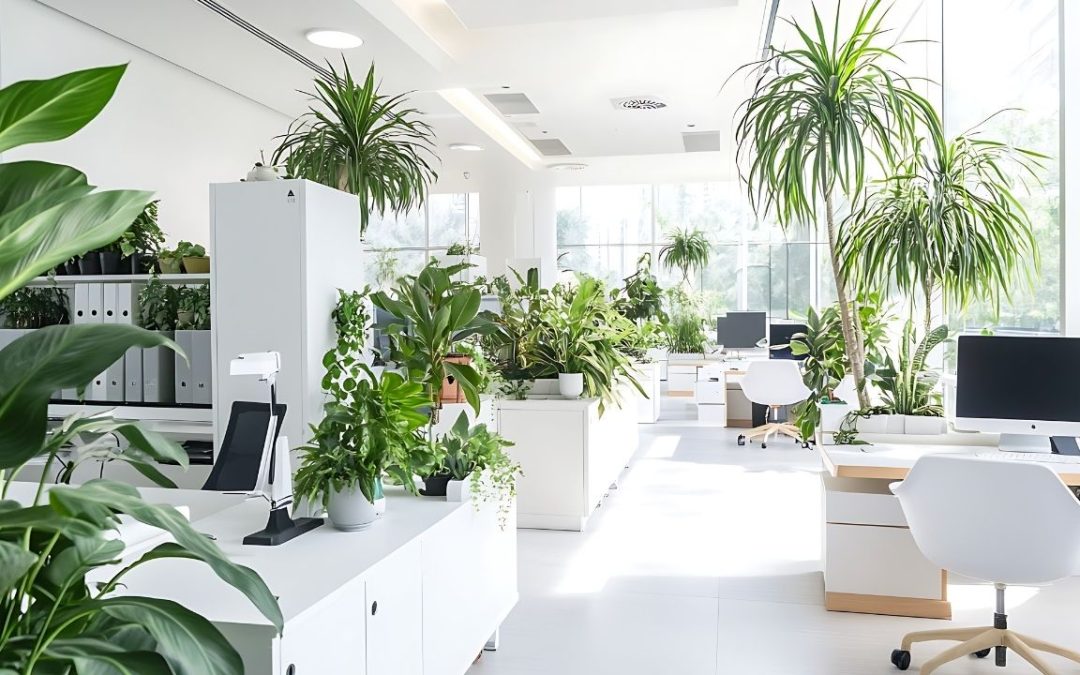
Key Takeaways:
- NASA’s 1989 Clean Air Study proved plants remove formaldehyde, benzene, and trichloroethylene through root-soil-microbe ecosystems that break down toxic compounds into usable nutrients.
- Dracaena and Philodendron thrive in Anaheim’s dry, air-conditioned offices while filtering multiple volatile organic compounds and tolerating low humidity levels typical of climate-controlled spaces.
- Plants require 10-1,000 per square meter to match HVAC ventilation rates, but practical densities of one plant per 100-150 square feet still provide measurable wellness benefits and perceived air quality improvements.
- Strategic plant placement near workstations and HVAC airflow patterns maximizes air purification effectiveness while positioning near collaborative areas benefits multiple employees simultaneously.
- Professional maintenance ensures sustained air quality improvements by handling watering schedules, pruning for optimal leaf surface area, pest control, and timely replacement to prevent performance gaps.
Indoor air quality directly affects workplace health and productivity. Modern office buildings trap pollutants inside sealed environments. Energy-efficient construction creates tighter building envelopes. This improves climate control but reduces natural air exchange. The result: concentrated levels of volatile organic compounds accumulate indoors.
Plants offer a scientifically validated solution through natural air purification processes. Dracaena and Philodendron species stand out for their proven effectiveness in commercial settings. These plants don’t just filter air. They actively break down harmful compounds into usable nutrients. This biological approach complements mechanical HVAC systems effectively.
Anaheim’s climate presents specific challenges for office environments. Dry air and consistent air conditioning create conditions where certain plants thrive. Understanding which species work best locally ensures successful implementation. This article examines the research behind plant-based air purification. We’ll explore why these specific plants work well in Anaheim offices and how to implement them effectively.
What Is Plant Air Purification in Commercial Office Environments?
Plant air purification uses natural biological processes to remove contaminants from indoor air. Unlike mechanical filters that trap particles, plants actively metabolize pollutants. This approach complements mechanical filtration systems in modern commercial buildings. The combination addresses both particulate matter and gaseous contaminants. Each method handles threats the other misses.
What types of indoor air pollutants are common in office buildings?
Office buildings contain multiple volatile organic compounds. Formaldehyde comes from furniture, carpeting, and pressed wood products. New office furniture off-gases this chemical for months after installation. Benzene originates in plastics, synthetic fibers, and cleaning products. Copy machines and printers release it during operation. Trichloroethylene appears in adhesives and paint removers. Maintenance activities introduce this compound regularly. Xylene comes from markers, printers, and rubber products. Even permanent markers contribute to indoor air pollution.
These chemicals accumulate in sealed, climate-controlled environments. Standard HVAC systems circulate but don’t eliminate them. Recirculated air spreads contaminants throughout the building. Without natural ventilation, concentrations build over time. EPA studies show indoor air can be two to five times more polluted than outdoor air.
How do indoor plants interact with airborne contaminants?
Plants remove pollutants through phytoremediation. Small pores on leaves called stomata absorb volatile organic compounds from surrounding air. These openings typically open during daylight hours for gas exchange. The plant transports these compounds to its roots through internal vascular pathways. This translocation process moves toxins away from leaves to root zones.
This process works continuously during plant metabolism. Each species shows different absorption rates for specific pollutants. Leaf surface area, stomatal density, and growth rate all affect performance. Larger plants with more foliage generally process more air volume. However, efficiency per unit of leaf area varies by species.
What role do leaves, roots, and soil microbes play in air purification?
The root-soil-microbe ecosystem forms the primary mechanism for VOC removal. Stomata on leaves absorb airborne contaminants first. Plants then transport absorbed compounds down to root systems.
Soil microorganisms surrounding the roots break down toxic compounds. They convert VOCs into harmless components the plant uses as nutrients. This complete cycle makes plant-based air purification effective for sustained use.
What Does Scientific Research Say About Plants and Indoor Air Quality?
Decades of research confirm plants improve indoor air quality. However, real-world applications differ from laboratory conditions.
What did the NASA Clean Air Study demonstrate about indoor plants?
The NASA Clean Air Study in 1989 first proved common indoor plants remove toxic VOCs from sealed environments. NASA researchers sought solutions for space station air quality concerns. They tested formaldehyde, benzene, and trichloroethylene removal rates across multiple plant species. The study concluded that the plant’s root-soil-microbe ecosystem drives purification. Soil bacteria proved as important as the plants themselves.
This foundational research established plants as viable air quality tools. It showed biological processes could supplement mechanical filtration. The study tested plants in sealed chambers over 24-hour periods. Researchers measured VOC concentration changes to quantify removal rates. Results demonstrated consistent pollutant reduction across tested species.
What limitations exist when applying lab studies to real offices?
Laboratory conditions don’t match typical office environments. A 2019 review by Cummings and Waring found VOC removal capability is real but limited in ventilated spaces. Achieving air cleaning rates comparable to standard building ventilation requires 10 to 1,000 plants per square meter.
Most offices can’t support such high plant densities. However, the study confirmed plants still provide measurable air quality improvements. They also deliver wellness benefits mechanical systems cannot replicate.
How do plants function alongside modern HVAC systems?
Plants complement rather than replace HVAC systems. Mechanical ventilation handles the bulk of air exchange. Plants address contaminants that mechanical systems recirculate.
The combination provides both mechanical and biological air treatment. Plants also offer psychological benefits that pure filtration lacks. This dual approach creates healthier work environments overall.
Why Are Dracaena and Philodendron Frequently Cited in Air Quality Studies?
Certain plant species consistently outperform others in research settings. Dracaena and Philodendron appear regularly in air quality literature for specific reasons.
What pollutants is Dracaena associated with filtering?
Dracaena species excel at removing formaldehyde, benzene, trichloroethylene, and xylene. Often called “dragon trees,” these plants tolerate low light and infrequent watering. Several varieties adapt well to office conditions. Dracaena marginata offers slender architectural form. Dracaena deremensis provides fuller foliage. Both varieties maintain effectiveness in typical fluorescent office lighting.
Their effectiveness spans multiple common pollutants. The low-maintenance nature allows consistent performance without intensive care. Watering every 7-10 days suffices for most indoor conditions. These plants tolerate missed waterings better than over-watering. Root rot from excessive moisture causes more failures than drought stress.
Why is Philodendron effective in indoor commercial settings?
Philodendron particularly targets formaldehyde and related VOCs. Large leaf surface area increases transpiration rates significantly. This helps regulate humidity while filtering air. Some varieties produce leaves exceeding 12 inches in length. Greater surface area means more stomata for gas exchange.
The fast-growing nature and lush foliage add visual appeal. Philodendron thrives in moderate light conditions common in commercial spaces. Heart-leaf varieties grow readily with minimal attention. Split-leaf types create dramatic focal points. Indoor plants like these actively improve air while enhancing aesthetics. They transform sterile office spaces into vibrant work environments.
How do these plants compare to other common interior office plants?
Both species rank among the most effective options for offices. They produce oxygen through photosynthesis while absorbing carbon dioxide. Water vapor release through transpiration increases indoor humidity naturally.
Their combined air purification and environmental regulation sets them apart. Other plants may excel in single areas, but these two provide comprehensive benefits.
Why Are Dracaena and Philodendron Well-Suited for Anaheim Offices?
Local climate significantly affects plant performance indoors. Anaheim’s specific conditions favor certain species over others.
How does Anaheim’s climate influence indoor plant performance?
Anaheim’s inland climate creates persistently dry indoor environments. Summer temperatures regularly exceed 90°F outdoors. Modern air-conditioned office buildings compound the dryness effect. Cooling systems remove moisture as they lower temperature. Dracaena and Philodendron thrive in the stable temperatures commercial HVAC systems provide. They evolved in environments with consistent warmth.
Both genera tolerate low humidity levels typical in air-conditioned spaces. This adaptation makes them reliable performers year-round. Many tropical plants struggle when indoor humidity drops below 40%. These species function effectively at 30-40% relative humidity. This matches typical Anaheim office conditions perfectly.
Why do these plants adapt well to office lighting conditions?
Dracaena tolerates low light exceptionally well. Most office environments provide sufficient indirect light for sustained growth. Philodendron performs best with moderate light but adapts to various conditions.
Neither species requires direct sunlight or special lighting. This flexibility allows placement throughout diverse office layouts.
How do foot traffic and space constraints affect plant selection?
Office environments present unique challenges for plant maintenance. High foot traffic and space limitations require hardy species. Minimal care requirements make Dracaena and Philodendron cost-effective choices.
Their resilience to typical office disruptions ensures consistent performance. Facilities managers appreciate plants that thrive despite irregular attention.
How Do Interior Plants Support Office Health Beyond Air Purification?
Plants provide multiple workplace benefits beyond VOC removal. These additional effects contribute significantly to employee wellness.
How do plants influence perceived air quality and comfort?
Plants balance indoor humidity naturally through transpiration. This prevents air from becoming excessively dry in climate-controlled spaces. Proper humidity levels reduce respiratory discomfort and dry skin complaints.
Oxygen production through photosynthesis refreshes indoor air continuously. Employees perceive improved air quality even when measurements show modest changes.
What evidence links interior plants to focus and reduced stress?
Research by Largo-Wight and colleagues in 2011 found natural contact at work reduces employee stress. The study measured cortisol levels and self-reported wellness indicators. Workers with plant access showed measurably lower stress markers. A 2000 study by Fjeld demonstrated interior planting improves health and reduces worker discomfort. Schools and offices with plants reported fewer illness complaints. The psychological benefits extend beyond physical air quality improvements.
Visual greenery creates calming environments. This supports focus and reduces workplace tension measurably. Natural elements in offices counteract the sterile feeling of modern commercial spaces. Biophilic design principles recognize humans’ innate connection to nature. Even small amounts of greenery trigger positive psychological responses.
Why does visual consistency matter in professional office environments?
Plants enhance workplace aesthetics significantly. Professional appearance contributes to overall workspace quality perception. Consistent design throughout an office reinforces brand identity and attention to detail.
The visual appeal creates positive first impressions for clients. Employees also respond favorably to well-maintained environments.
When Does Plant Air Purification Become Meaningful in Real Offices?
Implementation strategy determines actual results. Proper planning maximizes plant effectiveness in commercial settings.
What office sizes benefit most from interior plants?
All office sizes gain wellness benefits from plants. However, effectiveness depends on achieving adequate plant density relative to space. Even modest plant presence provides measurable employee wellness improvements.
Larger offices require more plants to achieve noticeable air quality effects. Smaller spaces see benefits with fewer specimens.
How does plant density affect results?
Research shows 10 to 1,000 plants per square meter would match building ventilation rates. This density level proves impractical for most offices. A 1,000 square foot office would need 930 to 93,000 plants at these densities. Floor space and maintenance requirements make this unfeasible. Lower densities still provide wellness benefits and some air quality improvement.
Practical implementations focus on supplemental benefits. The goal is enhancement rather than replacement of mechanical systems. Most offices achieve positive results with one plant per 100-150 square feet. This density provides noticeable aesthetic improvement and measurable wellness benefits. Employee perception of air quality improves significantly at this level.
Why placement matters more than plant count alone?
Strategic positioning maximizes plant effectiveness significantly. Consider HVAC airflow patterns when selecting locations. Plants near air returns process more circulated air. Position plants near workstations to maximize employee exposure to benefits. Direct proximity increases transpiration benefits and visual impact.
Account for available natural light even with low-light tolerant species. Windows provide supplemental light that improves plant health. Smart placement delivers better results than simply increasing plant numbers. Three well-placed plants often outperform six poorly positioned ones. Airflow, light, and employee proximity all matter more than total count.
How Should Dracaena and Philodendron Be Positioned in Offices?
Proper placement requires understanding both plant needs and office dynamics. Strategic positioning ensures maximum benefit with minimal disruption.
Where should plants be placed relative to workstations and airflow?
Position plants near employee workstations for direct benefit exposure. Desk corners and nearby credenzas work well for smaller specimens. Consider HVAC airflow patterns to maximize air purification reach. Vents and returns create circulation patterns that distribute processed air. Place specimens where they receive adequate light without blocking workspace functionality. Natural light from windows helps even shade-tolerant species.
Avoid locations with extreme temperature fluctuations or direct heating vents. Drafts from windows or doors stress plants unnecessarily. Plants near collaborative areas benefit multiple employees simultaneously. Conference rooms and break areas make excellent locations. Common spaces see high occupancy and benefit from plants’ calming effects.
How do containers and planters affect plant health?
Container selection impacts the root-soil-microbe ecosystem directly. Proper planters support water retention and drainage balance. Pots need drainage holes to prevent root rot. Saucers catch excess water and protect floors. Professional containers maintain plant health while enhancing aesthetic consistency. Matching planters throughout an office create visual cohesion.
Quality planters prevent water damage to floors and furniture. They also allow for easier maintenance access and plant rotation. Size matters for long-term plant health. Containers should accommodate root growth for 2-3 years. Too-small pots stress plants and require frequent repotting. Appropriate sizing reduces maintenance burden significantly.
What placement works best in open offices versus private suites?
Open offices benefit from distributed plant placement throughout the space. This provides coverage to all workstation areas evenly. Private suites allow concentrated greenery in individual executive spaces.
Consider foot traffic patterns in both configurations. Professional interior plant design accounts for these environmental factors systematically.
What Maintenance Factors Influence Long-Term Air Quality Benefits?
Sustained plant performance requires consistent care. Neglected plants lose effectiveness and aesthetic value quickly.
Why inconsistent care reduces plant performance
Regular maintenance keeps air purification capabilities functioning. Neglected plants lose effectiveness as health declines. Dust accumulation on leaves blocks stomata and reduces gas exchange. The root-soil-microbe ecosystem health directly impacts VOC removal capacity. Compacted soil reduces oxygen availability to roots and beneficial bacteria.
Irregular watering stresses plants and reduces transpiration. This diminishes both air purification and humidity regulation benefits. Overwatering kills more office plants than underwatering. Signs include yellowing leaves and soft stems. Proper drainage and watering schedules prevent these issues. Consistent attention maintains optimal plant performance year-round.
How watering, pruning, and pest control affect plant health
Proper watering maintains optimal transpiration rates. Soil should dry slightly between waterings for most office plants. Pruning supports healthy growth and preserves leaf surface area. Remove yellowed or damaged leaves promptly. This directs energy to healthy growth. Pest control prevents degradation of both plant health and appearance. Spider mites and scale insects attack stressed plants most readily.
Each maintenance aspect contributes to overall plant effectiveness. Combined attention ensures plants deliver sustained benefits over time. Fertilization provides nutrients the soil-microbe system needs. Quarterly feeding suffices for most office plants. Over-fertilization causes more problems than under-feeding. Professional services balance all these factors systematically.
When plant replacement becomes necessary
Plants eventually require replacement due to age or declining health. Regular assessment identifies specimens needing attention before they become eyesores. Timely replacement prevents gaps in air quality support and visual consistency.
Professional services handle replacement scheduling proactively. This maintains continuous coverage without management burden.
Can Interior Plants Replace Air Purifiers or HVAC Systems?
Setting realistic expectations prevents disappointment with plant programs. Understanding plant capabilities ensures appropriate implementation.
Why plants should be viewed as a supplemental solution
Plant air purification differs fundamentally from mechanical filtration. Practical office applications provide supplemental rather than primary air cleaning. The biological processes work slower than mechanical systems.
Plants offer unique wellness benefits beyond mechanical capabilities. They address psychological and environmental factors simultaneously.
How plants and mechanical systems work together
Plants complement existing HVAC systems rather than replacing them. Mechanical systems handle bulk air exchange efficiently. Plants address specific contaminants and provide wellness benefits.
The combined approach delivers both mechanical and biological air treatment. This integration creates healthier environments than either method alone.
What realistic outcomes offices should expect
Expect measurable improvements in perceived air quality and employee comfort. Plants provide effective humidity regulation in dry, air-conditioned spaces. Psychological and aesthetic benefits support workplace wellness noticeably.
Some VOC removal occurs as a supplemental benefit to mechanical systems. The combined effects create tangibly better work environments.
Which Anaheim Businesses Benefit Most From These Interior Plants?
Certain business types see greater returns from plant investments. Industry-specific factors affect implementation success rates.
Why offices and corporate environments are ideal
Controlled indoor climates suit Dracaena and Philodendron requirements perfectly. Professional appearance aligns naturally with corporate aesthetic standards. These plants complement modern office design without appearing casual. Employee density maximizes wellness benefit reach across the organization. Open floor plans allow plants to impact multiple workers simultaneously.
Corporate budgets typically accommodate ongoing maintenance needs. Office environments provide stable conditions for optimal plant performance. Temperature remains consistent during business hours. Lighting stays predictable on weekday schedules. These factors allow plants to establish strong growth patterns. Stability translates directly to better air purification performance.
How healthcare and hospitality settings differ
Healthcare facilities face different maintenance access challenges. Strict cleaning protocols and infection control requirements complicate plant care. Hospitality settings prioritize guest experience over employee wellness focus.
These industries may benefit from plants but require specialized approaches. Different species might prove more appropriate for their unique needs.
Why multi-location organizations prioritize consistency
Standardized plant selection ensures consistent appearance across all locations. Simplified maintenance protocols work efficiently across multiple sites. Predictable performance outcomes reduce variability between different office environments.
Brand consistency extends to interior design elements including plants. Multi-location organizations appreciate uniform approaches.
How Can Anaheim Offices Add Air-Supporting Plants Without Added Work?
Professional services eliminate the burden of plant maintenance. Strategic partnerships deliver benefits without internal resource demands.
Why professional plant design matters
Expert selection ensures climate-appropriate species for Anaheim conditions. Design integration supports aesthetic consistency throughout facilities. Professional assessment maximizes placement effectiveness from the start.
Specialists understand both horticultural requirements and office functionality. They balance both considerations in planning stages.
How ongoing maintenance protects long-term results
Regular care maintains plant health and air purification capability continuously. Professional plant services ensure consistent quality without internal effort. Scheduled maintenance prevents decline in both appearance and performance.
Service providers handle watering, pruning, pest control, and replacement. This removes the burden from facilities management entirely.
What decision-makers should evaluate before installation
Assess available space and current layout configurations. Evaluate lighting conditions and HVAC system characteristics thoroughly. Consider maintenance budget options and available service providers.
Define desired aesthetic outcomes and specific wellness goals. These factors guide appropriate plant selection and placement strategies.
Using Interior Plants to Support Healthier Anaheim Offices
Scientific evidence supports plant benefits when properly maintained. Success requires appropriate species selection and strategic placement. Ongoing maintenance remains essential for sustained results.
Why plant performance depends on planning and care
Plants deliver advertised benefits only with consistent attention. Proper species selection for local climate conditions ensures viability. Strategic placement maximizes impact on air quality and employee wellness.
Professional planning addresses these factors comprehensively. DIY approaches often miss critical considerations.
How professional interior plant services support consistency
Expert care ensures optimal plant health year-round. Consistent service maintains both appearance and effectiveness reliably. Professional providers handle replacement and troubleshooting proactively.
This eliminates variability in plant performance. Offices receive predictable benefits without internal resource allocation.
What the next step looks like for Anaheim offices
Start with an assessment of the current office environment and specific needs. Schedule design consultation for plant selection and placement planning. Implement maintenance plans for long-term success and sustained benefits.
Contact professional services to begin the process. Expert guidance ensures optimal outcomes from initial planning through ongoing maintenance.
Transform Your Anaheim Office With Expert Plant Solutions
Your employees deserve to work in environments that support their health and productivity. Mr. PlantSoCal specializes in designing and maintaining interior plant systems for Anaheim offices. Our team handles everything from initial assessment through ongoing care, ensuring your plants deliver consistent air quality benefits without adding to your facilities workload.
Ready to improve your office environment? Contact Mr. PlantSoCal today for a consultation. We’ll evaluate your space, recommend the ideal plant selection for your specific conditions, and create a maintenance plan that keeps your office looking professional and your air quality optimized year-round.

